You brush every morning. You floss most nights. You rinse. You do the work. So why does your dentist still find buildup at your cleaning appointment? This is one of the most common questions patients ask at a general dentistry clinic . The short answer is that home care and professional care do different jobs. Both matter. Neither one replaces the other.
Here at Chester Dental Care, a general family dentistry practice in Chester, VA , we serve Richmond, Chesterfield, Midlothian, and nearby areas, and this topic comes up at nearly every new patient visit. Understanding the difference helps you get more out of both.

Key Takeaways
-
Brushing and flossing at home removes plaque, but not tartar. Once plaque hardens into tartar, only a dental professional can remove it.
-
Professional cleanings reach spots your toothbrush cannot. Between teeth, below the gumline, and along the back molars are common problem areas.
-
Skipping professional cleanings lets small problems grow. Cavities, gum disease, and bone loss often start without any pain.
-
Most adults need a professional cleaning every six months. Some patients with gum disease may need more frequent visits.
-
Home care and professional care work together. One does not replace the other. Both are part of routine dental care.
What Home Teeth Cleaning Actually Does
Home cleaning removes plaque, food debris, and some surface staining from accessible tooth surfaces.
Plaque is a soft, sticky film of bacteria that forms on teeth throughout the day. Brushing twice a day and flossing daily removes most of it. That matters a lot. Consistent home care is the foundation of good oral health.
But home cleaning has limits. Your toothbrush cleans the front, back, and top of each tooth. Floss cleans between teeth. What neither tool can do is clean deep below the gumline, where bacteria collect in the small pockets between your gum and tooth root.
Home care also cannot remove tartar. When plaque sits on a tooth for 24 to 72 hours without being removed, it can harden into tartar, also called calculus. Tartar bonds to enamel and cannot be brushed or flossed off. It requires a dental instrument to remove.
Areas home cleaning often misses:
-
The back surfaces of upper and lower molars
-
Along and just below the gumline
-
Between teeth, especially when crowded
-
Around dental work like crowns, bridges, or implants
What a Professional Dental Cleaning Does
A professional cleaning removes tartar, cleans below the gumline, polishes tooth surfaces, and gives a dentist the chance to spot problems before they grow.
Professional cleanings are performed by a registered dental hygienist, typically as part of a general dentistry services appointment. The process is more detailed than most patients expect.
Here is what happens during a standard professional cleaning:
-
Tartar removal (scaling): The hygienist uses a scaler, a small metal instrument, to carefully scrape tartar from tooth surfaces and below the gumline. Some offices also use an ultrasonic scaler that vibrates tartar loose with water.
-
Polishing: A rotating brush with gritty toothpaste polishes the enamel surface, removing light stains and smoothing the tooth so plaque has a harder time sticking.
-
Flossing: Professional flossing reaches between every tooth, clearing debris and checking for sensitivity or bleeding.
-
Rinsing: A rinse flushes debris from the mouth.
-
Examination: A dentist reviews your X-rays, checks for cavities, examines the gums, and evaluates the soft tissues of the mouth. This is where early problems get caught.
According to the Centers for Disease Control and Prevention, 47.2% of adults aged 30 and older have some form of periodontal (gum) disease . Many of those cases developed slowly and without noticeable pain, exactly the kind of progression that professional exams are designed to catch.
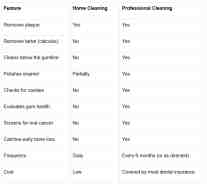
Routine Dental Care: Side-by-Side Comparison
Why Tartar Is the Key Difference
Tartar is the dividing line between what you can do at home and what requires a professional.
Once tartar forms, it acts as a rough surface where more plaque sticks. That plaque irritates the gums. Irritated gums pull away from the tooth slightly, creating deeper pockets. Bacteria settle into those pockets. The gums become inflamed; this is gingivitis.
Left longer, the inflammation spreads to the bone that holds the tooth in place. This is periodontitis, a more serious form of gum disease that can lead to tooth loss.
The chain looks like this:
Plaque not removed → Hardens into tartar → Irritates gums → Gingivitis → Periodontitis → Bone loss → Tooth loss
Breaking that chain early is the purpose of routine dental care. A professional cleaning every six months interrupts the process before it advances.
How Often Do You Actually Need a Professional Cleaning?
For most healthy adults, twice a year is the standard. But that is not a rule that fits everyone.
Patients with active gum disease, a history of heavy tartar buildup, diabetes, or dry mouth often need cleanings every three to four months. Patients with dental implants may need more frequent visits to protect the tissue around the implant.
Your general dentistry clinic sets the schedule based on your specific mouth, not a one-size-fits-all calendar.
Children need professional cleanings, too. General family dentistry practices see patients of all ages. Starting early builds habits and gives the dentist a chance to track how teeth are developing.
What Happens When Professional Cleanings Are Skipped
It is easy to put off a dental appointment. Life gets busy. There is no pain, so it feels fine to wait.
But gum disease and tooth decay do not always hurt until they are well advanced. A cavity in its early stages has no pain. Gum inflammation may only show up as slight bleeding when brushing, something many people dismiss.
According to the National Institute of Dental and Craniofacial Research (NIDCR) , tooth decay is the most common chronic disease in children and adults in the United States. Most of those cases were preventable with consistent professional care.
Skipping one cleaning becomes skipping two. By the time something hurts, the situation is often more involved and more costly to treat.
Advanced dentistry procedures like root canals, crowns, and tooth extractions are sometimes the result of problems that started small and were caught late. General dentistry services are built to prevent that outcome.
General Dentistry: Tips for Getting the Most Out of Home Cleaning
Professional cleanings are more effective when your home care is consistent. Here is what makes a real difference:
-
Brush for two full minutes, twice a day. Most people brush for 45 seconds. Two minutes gives the fluoride in toothpaste time to work.
-
Use a soft-bristled brush. Hard bristles can wear down enamel and irritate gums over time.
-
Floss once a day, ideally before bed. This removes the food and plaque that your brush cannot reach between teeth.
-
Replace your toothbrush every three months. Worn bristles do not clean as well.
-
Drink water throughout the day. Water rinses food away and helps maintain saliva production, which naturally protects teeth.
None of these steps replaces a professional cleaning. But they make the time between appointments count.
General Family Dentistry FAQ
Does a professional cleaning hurt?
For most patients, no. Some sensitivity is normal, especially if tartar has built up near the gumline or if it has been a while since your last cleaning. If you have gum disease or sensitive teeth, let your hygienist know ahead of time.
Can professional cleaning whiten my teeth?
Polishing during a cleaning removes surface stains and brightens teeth, but it is not the same as a whitening treatment. Deep whitening requires a separate procedure. You should talk to your dentist for more specific information on the whitening services they provide.
Is general dentistry in Chester covered by insurance?
Most general dentistry clinics recommend two professional cleanings per year, and most dental insurance plans cover both visits. However, you should check with your provider for details specific to your personal plan.
What if I have not been to the dentist in years?
Start now with a regular cleaning and exam appointment. Your dentist will assess where things stand and recommend a care plan from there. There is no judgment; the goal is to get you on track with a beautiful and healthy smile.
Home Care and Professional Care Both Have a Role
Good oral health comes from both ends. At home, you put in the daily work. In our office, we specialize in handling what your tools cannot reach.
Missing either side of
routine dental care
leaves gaps. Regular brushing slows tartar from forming and minimizes plaque creation. Our professional cleanings
remove the rest. Together, we give your teeth and gums the best chance.

Schedule Your Cleaning at Chester Dental Care in Chester, VA.
Our team at Chester Dental Care provides general dentistry services for patients in Chester, Richmond, Chesterfield , Midlothian, Hopewell, and surrounding areas in Virginia. With nearly two decades of dental experience and a consistent, knowledgeable team, the practice focuses on long-term oral health, not just the appointment in front of you.
Call today at (804)748-2555 or email frontdesk@chesterdentalcareva.com to schedule your routine dental care visit.
Recent Posts

General Dentistry vs. Airway-Centered Care: Why Chester Dental Care Offers Both
Shwetha Rodrigues | October 7, 2026
Dental Implants vs. Bridges vs. Dentures: Comparing Your Tooth Replacement Options
Shwetha Rodrigues | September 15, 2026
Do I Need a Pediatric Dentist, or Can My Child See My General Dentist?
Shwetha Rodrigues | July 30, 2026Breathe Right.
Sleep Tight.
Smile Bright.
Request Your Appointment