Most people visit the dentist when something hurts. A toothache, a cracked filling, a swollen gum. By that point, the problem has usually been developing for months, sometimes years.
Preventive dentistry works differently. It finds and addresses problems before they cause pain, and before they require expensive, time-intensive treatment. If you're looking for general dentistry in Chester that keeps your whole family out of the dental chair for anything other than routine visits, this is the approach that makes that possible.
Here's what the research shows, what preventive care at Chester Dental Care actually includes, and why we believe it matters more than most people realize.
Key Takeaways
-
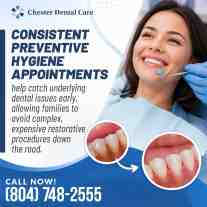
Preventive dental visits at a general dentistry clinic catch small problems early, before they develop into costly procedures like root canals or extractions.
-
Gum disease affects nearly half of adults over 30 and is largely preventable with consistent routine dental care.
-
Every dollar spent on preventive dentistry saves an estimated $8 to $50 in restorative and emergency treatment costs down the line.
-
Professional cleanings remove tartar that brushing and flossing alone cannot, reducing the risk of decay and bone loss.
-
General dentistry services that include early childhood care give kids a significantly better chance of avoiding orthodontic or restorative treatment as adults.
What Is Preventive Dentistry and What Does It Include?
Preventive dentistry is a category of general dentistry services focused on maintaining oral health and stopping problems before they start. It includes both professional care at a general dentistry clinic and the habits you build at home.
At the clinical level, preventive care typically includes:
-
Routine dental cleanings (prophylaxis) every 6 months, or more frequently for higher-risk patients
-
Full oral exams with periodontal charting to measure gum health
-
Digital X-rays to detect decay, bone loss, and structural issues not visible to the naked eye
-
Oral cancer screenings during every exam
-
Fluoride treatments to strengthen enamel against decay
-
Dental sealants applied to the chewing surfaces of back teeth, particularly in children
-
Custom mouthguards for patients who grind their teeth at night
At home, preventive care means brushing twice daily, flossing once daily, staying hydrated, and managing any systemic health conditions that affect oral health, such as diabetes or acid reflux.
Together, these two layers of care create a consistent barrier against the most common dental problems.
How Does Preventive Care Stop Small Problems From Becoming Big Ones?
Tooth decay and gum disease both progress in stages. Catching either condition early means treatment is simpler, less invasive, and less expensive.
Take tooth decay as an example. In the earliest stage, decay appears as a white spot on the enamel surface. At this point, a fluoride treatment or dietary adjustment can often reverse it entirely. No drilling, no filling.
Left untreated, that same decay moves through the enamel into the dentin layer beneath. Now it requires a filling. If it reaches the pulp (the inner chamber of the tooth containing nerves and blood vessels), it requires a root canal. If the tooth becomes structurally compromised, it may need a crown. If it's lost entirely, the patient is looking at an implant or bridge.
That progression from a reversible white spot to a tooth replacement procedure can happen over a period of just two to three years, often without any noticeable pain until the later stages.
Gum disease follows a similar pattern. In its earliest form, gingivitis, the gums are inflamed, but the damage is still reversible with a professional cleaning and improved home care. Left untreated, gingivitis can advance to periodontitis, a chronic infection that breaks down the bone and tissue supporting the teeth. At that stage, the goal shifts from reversal to management. Treatments like scaling and root planing, and in more advanced cases, surgical intervention, become necessary to slow its progression and preserve remaining bone.
Routine dental care interrupts both progressions at the earliest point. That's the core value of preventive dentistry.
What Does Research Say About Preventive Dentistry and Cost Savings?
The financial case for preventive dental care is well-supported by data.
According to the University of Illinois Chicago College of Dentistry , for every dollar invested in preventive dental care, patients saved between $8 and $50 in restorative and emergency treatment costs.
The savings come from avoiding the most expensive procedures in dentistry: root canals, crowns, extractions, implants, and periodontal surgery. Each of these is many times more costly than the cleaning or exam that could have prevented them.
For families managing multiple household members' dental care, consistent preventive visits at a general family dentistry practice represent meaningful long-term savings, not just a recurring expense.
Why Is Gum Disease So Important to Catch Early?
Gum disease (periodontal disease) is one of the most common and preventable causes of tooth loss in adults. It also has documented links to systemic conditions, including heart disease, diabetes, and preterm birth.
According to the CDC , nearly 47% of adults aged 30 and older have some form of periodontal disease. That figure rises to 70% among adults 65 and older.
The challenge with gum disease is that it's largely painless in its early stage (called gingivitis). Most people don't notice it until inflammation, bleeding, or recession has already progressed.
At a preventive visit, your dental hygienist measures the depth of the pockets between your gums and teeth. Healthy pockets measure 1 to 3 millimeters. Measurements of 4 millimeters or more indicate early to moderate disease. At that stage, a deep cleaning procedure called scaling and root planing can treat the infection and restore gum health without surgery.
Wait until the disease advances to the bone, and the treatment options become more complex and less reversible.
Preventive vs. Restorative Dentistry: What's the Difference in Cost and Complexity?
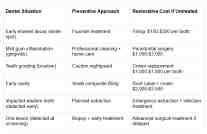
The pattern is consistent. Early detection and preventive treatment cost a fraction of what delayed treatment requires, and they preserve more of your natural tooth structure in the process.
How Does Advanced Dentistry Support Preventive Care?
Advanced dentistry tools allow problems to be detected earlier and treated more conservatively than older methods allowed.
At Chester Dental Care, we've built our approach around adopting newer technologies as they become available. Digital X-rays reduce radiation exposure while producing higher-resolution images. Intraoral cameras let you see exactly what we see, which supports informed decision-making.
For patients with sleep-disordered breathing or airway concerns, advanced diagnostics help connect oral health findings to broader health patterns. This is particularly relevant for parents bringing children in for routine visits, where early signs of airway development issues can be identified before they require more involved intervention.
Preventive care at this level goes well beyond checking for cavities. It's an assessment of how your oral health fits into your overall health picture.
What Role Does General Family Dentistry Play in Long-Term Oral Health?
Seeing the same dental team consistently over time is one of the most underrated factors in preventive care. A provider who knows your history can detect subtle changes that a new provider might miss.
General family dentistry serves patients of all ages under one roof. That means a practice can track a child's dental development from their first visit through adolescence, catch early orthodontic concerns, and support parents in building habits that carry into adulthood.
At Chester Dental Care, low staff turnover means the team that sees your child at age 7 is likely the same team that cleans your teeth twice a year. That continuity creates a dental record and a relationship that works in your favor over time.
For adults, consistent visits allow the team to track changes in gum pocket depths, enamel wear, and tissue appearance year over year. A 1-millimeter increase in pocket depth between visits is a meaningful data point. Without that longitudinal record, it's just a number.
What Can You Do Between Appointments to Protect Your Oral Health?
Strong at-home habits extend the value of every professional visit.
-
Brush for two full minutes twice daily using a soft-bristle toothbrush and fluoride toothpaste.
-
Floss once daily, reaching below the gumline on both sides of each tooth.
-
Drink water throughout the day to maintain saliva flow, which neutralizes acids and rinses bacteria.
-
Limit sugary and acidic foods and drinks, particularly between meals when saliva production is lower.
-
Replace your toothbrush every three months or after any illness.
-
Wear your nightguard if one has been prescribed, since grinding accelerates enamel wear dramatically.
-
Schedule and keep your routine appointments, even when nothing feels wrong.
The patients who avoid the most expensive dental treatment over their lifetimes are not the ones with naturally perfect teeth. They're the ones who show up consistently and follow through on home care. That's what a good general dentistry clinic makes possible: a simple routine that protects your health long-term.
Schedule Routine Dental Care at a General Dentistry Clinic in Chester
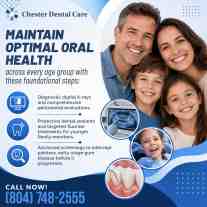
Preventive dentistry is the most direct path to fewer procedures, lower costs, and better oral health over time.
Chester Dental Care is a general dentistry clinic in Chester, VA, serving patients from Chesterfield, Richmond, Midlothian, Hopewell, Henrico, and nearby areas in Virginia. We bring close to two decades of dental experience to every appointment, and our team collaborates across medical disciplines to provide care that looks at the full picture of your health.
Whether you're scheduling a first visit for your child, overdue for your own cleaning, or managing a health condition that affects your oral health, we're ready to help.
Call us at (804)748-2555 to book your appointment. We are also available via email at frontdesk@chesterdentalcareva.com .
We treat general dentistry patients of all ages and believe that the best dental visit is the one where we find nothing to fix. Consistent preventive care makes that outcome far more likely.
Medical Disclaimer
The information provided in this blog is for educational purposes only and does not constitute professional medical advice, diagnosis, or treatment. Always seek the advice of your physician or other qualified health provider with any questions you may have regarding a medical condition.
Recent Posts

General Dentistry vs. Airway-Centered Care: Why Chester Dental Care Offers Both
Shwetha Rodrigues | October 7, 2026
Dental Implants vs. Bridges vs. Dentures: Comparing Your Tooth Replacement Options
Shwetha Rodrigues | September 15, 2026
Do I Need a Pediatric Dentist, or Can My Child See My General Dentist?
Shwetha Rodrigues | July 30, 2026Breathe Right.
Sleep Tight.
Smile Bright.
Request Your Appointment